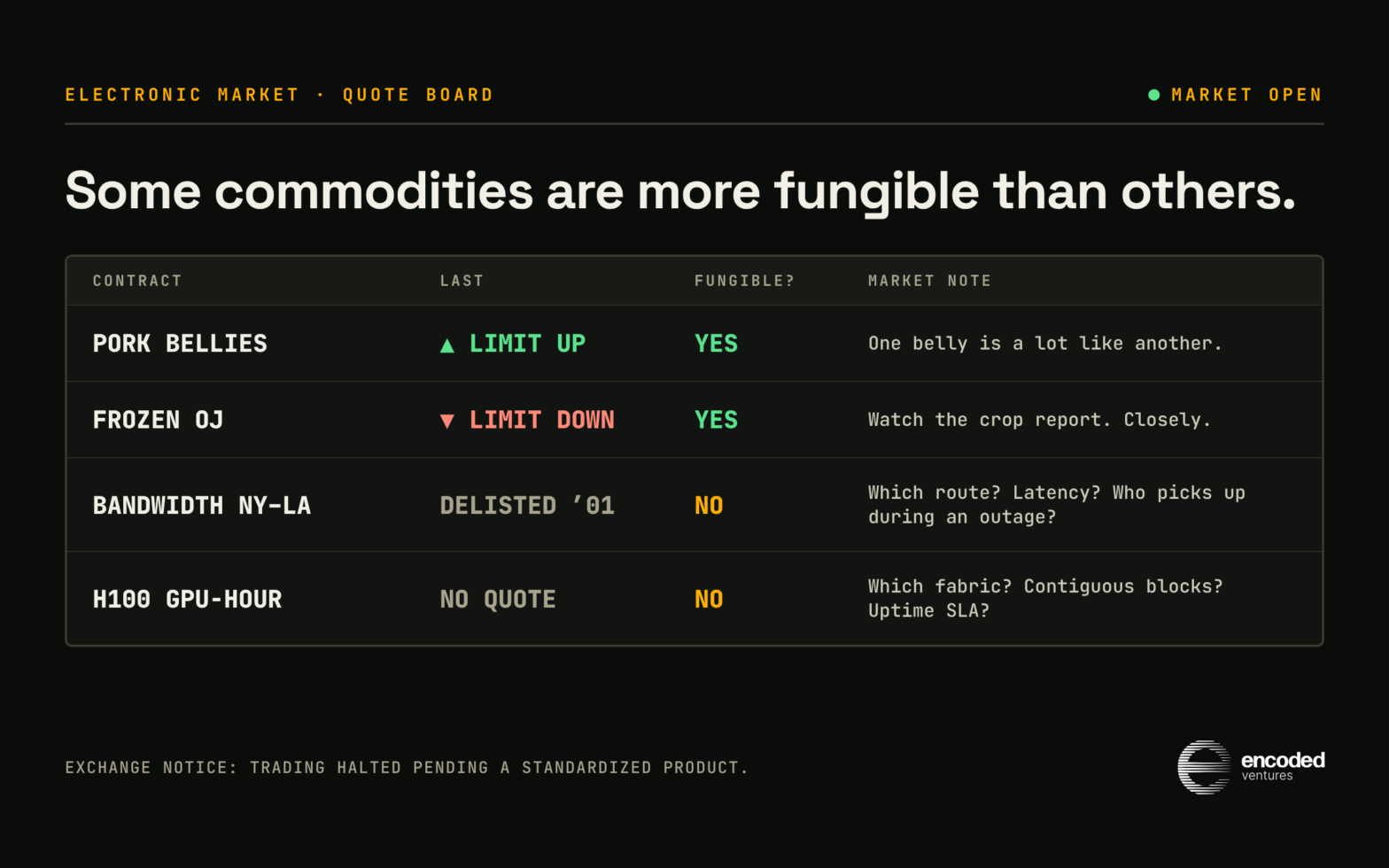
Bandwidth is cheap. The bytes you have to hold in flight are not.
Chris Zeoli’s piece on why AI is a memory / storage workload is a great read. Inference is stateful now, that state has to live somewhere, and the memory-storage boundary is where value is moving. I agree with all of it.
But watch how people evaluate that boundary. They quote latency to the accelerator. Microseconds to the drive. IOPS off the spec sheet. Those are the wrong numbers, and they lead to the wrong optimizations.
The number that matters is bandwidth-delay product. Bandwidth × latency tells you how much data must be outstanding at all times to hit rated throughput. Below that line, the link idles regardless of how fast the media is.
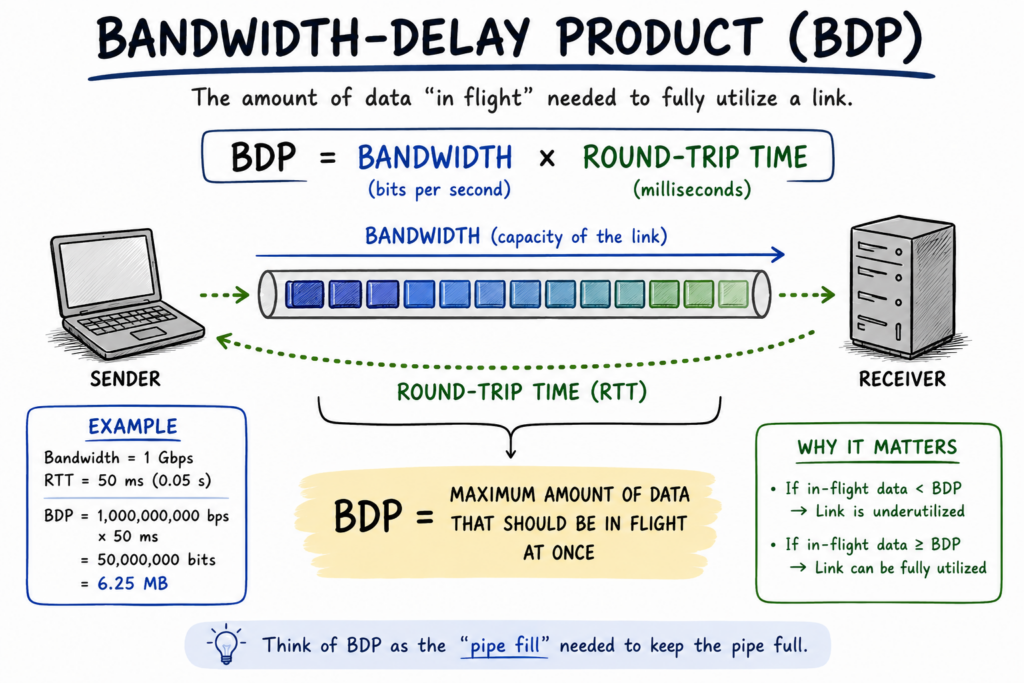
Networking settled this years ago, but with the terms reversed. On the internet, delay is fixed by physics, so the only lever was bandwidth. In the datacenter it’s the opposite: bandwidth is cheap and SERDES roughly doubles every two years, while the latency of crossing a tier barely moves. Multiply those two trends together. The bytes you must hold in flight double every hardware generation, and nothing you can buy reduces them.
Freight makes this concrete. If a trip takes 24 hours and you need one truckload delivered every hour, you need 24 truckloads on the road at all times. Bigger trucks don’t change that: double the payload and you halve the fleet, but the tonnage in transit is identical. Only a shorter trip does.
Run it on inference, in bytes rather than tokens:
KV bytes = 2 × layers × kv_heads × head_dim × dtype_bytes × tokens
Note kv_heads, not attention heads, because grouped-query attention means a 70B-class model has 8 of the former and 64 of the latter, and the cache scales with the smaller number. So 2 × 80 × 8 × 128 × 2 = 320 KiB per token, and a 128K-token session is ~42GB of state.
That state is created during prefill, lands in DRAM, and moves up and down from there. Flash is spill and cross-session persistence, not the steady-state path. But the cold case is the one that sets the budget: 42GB off a Gen5 drive at 14.8 GB/s takes ~2.9 seconds. For comparison, the Jeff Dean-style community latency list everyone knows now carries a 2026 entry for long-context prefill (~100K tokens, no cache) at 10 seconds. Reading state back beats regenerating it by 3–4x. That gap is the whole argument for caching.
So target 200ms to first token. You need ~215 GB/s, which is fifteen drives in parallel or a networked tier. At ~200µs of fabric round-trip, sustaining that means holding 43MB in flight, continuously, just to keep prefill fed.
Faster flash is a bigger truck, not a shorter trip. No vendor can sell you that 43MB. It doesn’t exist at the media layer. It only exists in whatever schedules across drives, across tiers, across sessions.
And this is strictly a caching problem, with one unusual property: the miss penalty isn’t a read from a slower store, it’s recompute on a GPU. Effective latency is hit time plus miss rate times miss penalty, and you only improve it two ways: raise the hit rate through placement, or hide the penalty through concurrency. Both are scheduling.
Placement is where it gets hard. KV moves in chunks: vLLM’s default block is 16 tokens, about 5 MiB; LMCache’s default chunk is 256 tokens, about 80 MiB. Bigger chunks give you bandwidth efficiency but coarser prefix matching, since partial hits round down and you drag in tokens nobody asked for. Smaller chunks match reuse precisely and walk you off the bandwidth cliff. No amount of faster flash resolves that, and the right answer changes per workload.
So the scarce thing is not the flash. NVIDIA named the tiers. The NAND makers are shipping the media. What nobody owns is the layer that decides what sits where and keeps every pipe between them saturated under multi-tenant load, a requirement that, per the arithmetic above, gets harder every generation rather than easier.
The bet I’d make is that this layer gets owned by software rather than by anyone shipping media. Hierarchical memory / storage management is going to create a lot of value for someone!
I’m spending real time on this at Encoded and looking at companies building in this layer. If you’re working on placement, tiering or cache management for inference, I’d like to talk. If you’ve got benchmarks that argue the other way, I’d like that even more.