When we talk about GPU performance, we obsess over throughput. More tokens per second. Faster inference. But we’re missing a critical insight: the relationship between power and performance is deeply nonlinear, and that nonlinearity has massive implications for data center economics. Provisioned power is the long pole in the datacenter tent. Stop wasting what you already have!
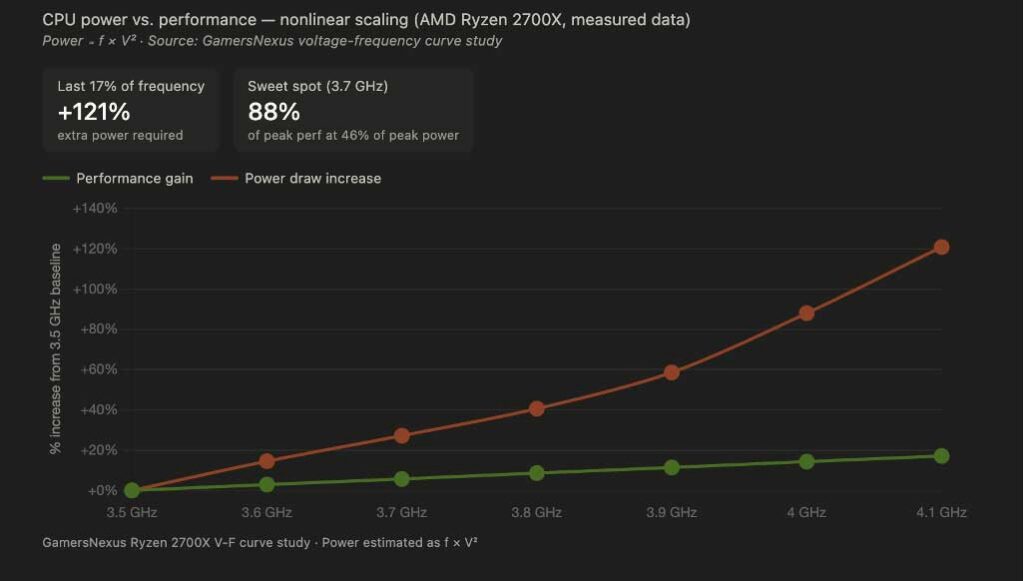
The physics is straightforward but brutal. Dynamic power in semiconductors scales with frequency times voltage squared. That squared term is the culprit. When you push a GPU or CPU from eighty percent to one hundred percent of its rated power, you’re not getting twenty percent more performance. You’re getting maybe five to ten percent more, because you’re climbing the steepest part of the efficiency curve. The last seventeen percent of clock speed requires over a hundred and twenty percent more power to sustain. This isn’t a quirk. It’s fundamental to how silicon works.
For CPUs, the data is clear. Research from Intel and AMD shows that higher-TDP chips can deliver better performance per watt despite their raw power draw, because they’re operating in a more efficient region of their voltage-frequency curve. The practical takeaway: you can get eighty percent of peak performance at roughly forty to fifty percent of maximum TDP. That’s where the sweet spot lives.
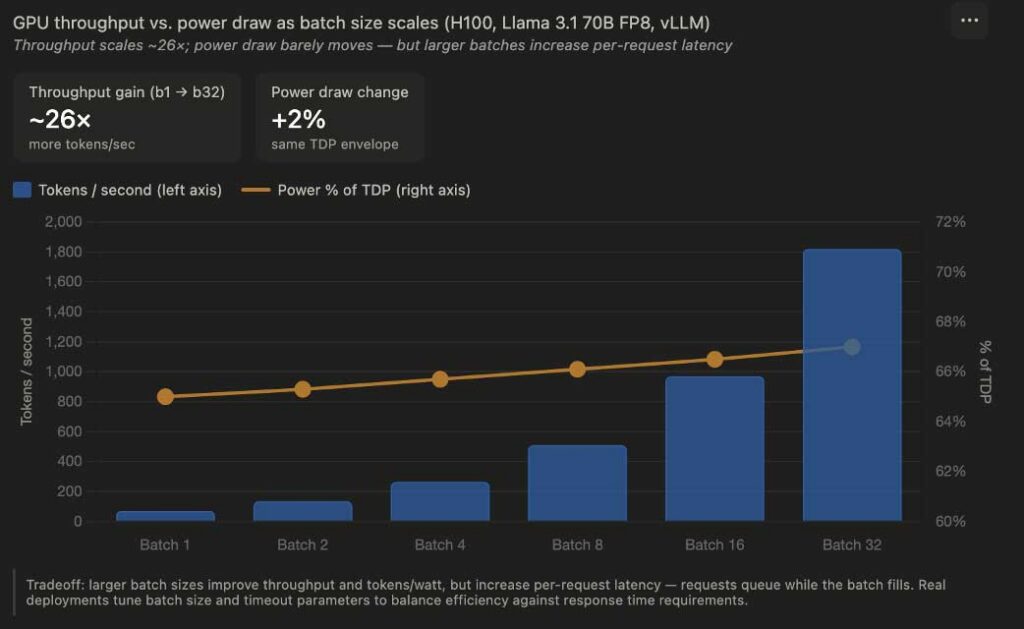
GPUs follow the same physics. The H100 dominates energy per token across nearly all models, but here’s the crucial part: token efficiency per watt depends heavily on batch size and quantization. Going from batch size one to batch size thirty-two delivers twenty to forty times more throughput at identical power draw. FP8 quantization versus FP16 adds another thirty to forty percent without touching power consumption. Manufacturers deliberately tune voltage-frequency curves to find that sweet spot where performance stays excellent without becoming a thermal nightmare.
But there’s a second layer to this story, and it’s where things get interesting for brownfield operations.
The Spiky Problem
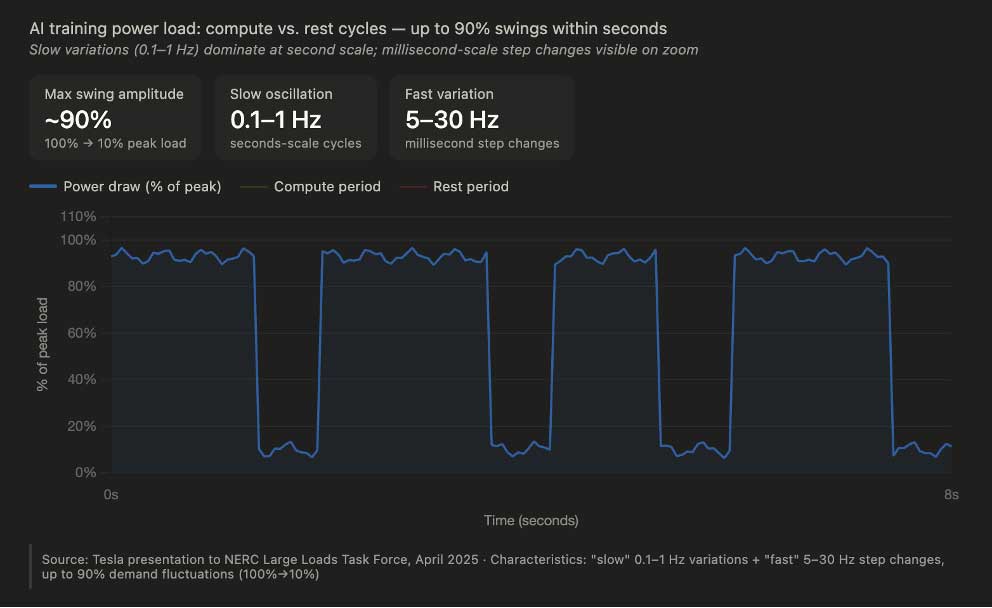
GPU workloads aren’t steady. Training incurs massive power swings—up to 37.5% of provisioned capacity within two seconds. Inference is calmer, but still volatile.
There’s a subtler physics problem beneath the spikes, too. The magnitude of the current surge a GPU rack generates depends on when load is admitted relative to the AC sine wave. Admitted at the zero crossing, the transient is minimal. Admitted at the crest, it’s worst-case. Data center power delivery infrastructure—PSUs, feeders, substations—gets sized for that worst-case transient. It’s a double penalty: you overprovision for the average-to-peak swing, and then you overprovision again for the worst-case transient within that peak.
This is compounded by how the industry calculates capacity. The standard method is max TDP × GPU count—a ceiling that production workloads rarely approach. The gap between that ceiling and actual consumption is what we call stranded power.
When you run three GPUs at full power, you’re provisioning your entire infrastructure—power supplies, PDUs, cooling systems—for peak draw, not average draw. That’s capex you’re paying for upfront, plus ongoing cooling costs and thermal stress that degrades hardware faster.
Here’s where the economics get interesting. Running four GPUs at lower power instead of three at full tilt actually generates more tokens per second per watt. You avoid the cubic penalty of pushing into the steep part of the efficiency curve. But in greenfield scenarios, that fourth GPU costs money. You need thirty-three percent more throughput just to break even on the hardware capex.
Brownfield is different. If your power budget is fixed—you’ve already built your facility, and you’ve got a hard limit on available watts—the equation flips. Four GPUs at lower power, running steadier and cooler, extract way more throughput from the power you’ve already provisioned. You’re not buying infrastructure upgrades. You’re squeezing more value from existing constraints.
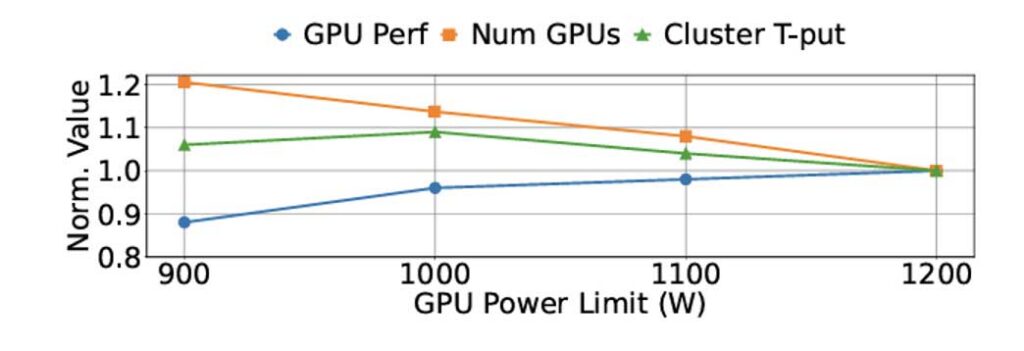
This is not just theoretical. Meta recently published data from their 150 MW GB200 cluster confirming this: provisioning GPUs at 80% of TDP increased total cluster throughput by nearly 11%, simply by fitting more accelerators within the same power envelope. Figure 9 from this paper tells the story.
Why Quantization and Batching Are Power Multipliers
Two techniques deserve special attention because they exploit this nonlinearity so effectively.
Quantization—going from FP16 to FP8—lets you represent numbers with fewer bits. That means less data moving through the GPU’s memory system and fewer arithmetic operations needed to process each token. Memory bandwidth and data movement are huge power consumers on GPUs. When you quantize, you’re cutting the data volume roughly in half, so you move less stuff around. The arithmetic units do the same work with smaller numbers. But the TDP stays flat because you’re not pushing harder—you’re just being more efficient about what you’re already doing. Bill Dally, NVIDIA’s Chief Scientist, presented the following chart at Hot Chips in 2023, showing that numerics was by far the largest contributor to inference performance increases at the hardware level. FP4 for both weights and activations is now native in Blackwell, the next step down the precision ladder — and early benchmarks show minimal accuracy loss.
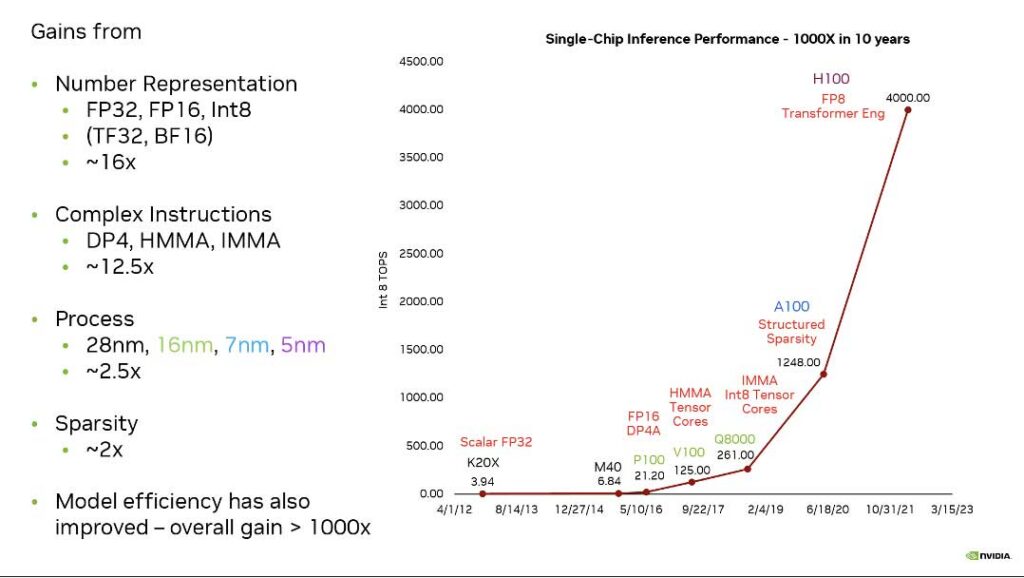
(NVIDIA Hot Chips 2023 Keynote)
Batch size works differently. When you go from batch one to batch thirty-two, you’re not changing the power draw of the GPU at all. You’re feeding it more work at once—same utilization, same temperature, same watts. But because you’re processing thirty-two requests in parallel instead of one, your throughput explodes. That’s the twenty to forty times gain. Same power, way more output.
The tradeoff is latency. Larger batches mean requests wait in queue until the batch fills before processing begins. A request in a batch of 32 waits for the other 31. For latency-sensitive applications where time-to-first-token matters—chatbots, real-time APIs—operators tune batch size and timeout parameters carefully. Offline workloads like bulk inference, embeddings, and data processing can tolerate the wait and capture the full efficiency gain.
Neither of these techniques pushes the GPU harder. They make the GPU work smarter. You’re staying in that efficient region of the curve instead of climbing toward the steep part.
The Takeaway
The myth of “more power equals more performance” has distorted how we think about GPU infrastructure. The reality is messier and more interesting. Peak efficiency happens well before peak power. And in brownfield operations, that insight becomes economically decisive.
The long pole in the supply chain isn’t GPUs or memory, it’s provisioned power. The companies winning at scale aren’t chasing raw GPU throughput. They’re optimizing the power envelope they already have. If you’re interested in learning more about co-optimizing throughput and power to maximize all your provisioned watts, check out Niv-AI.