Jake’s post on bandwidth trading and today’s push to financialize GPU compute is one of the better things I’ve read this year. It hits close to home: I was in the room for a small piece of the first act.
One of the first board meetings I joined at Battery, in 2001, was for Cinta Networks, which was building an integrated optical switch plus DWDM system based on tunable lasers. The goal was to collapse the switching and long-haul transport layers into a single box. By March 2001 the company had raised more than $64 million from a group that included Battery, Sequoia, Corning, ADC, and Enron.
In other words, one of the companies betting that bandwidth would trade like a commodity was also funding the equipment vendors whose gear would carry that bandwidth.
Circular deals aren’t new. Enron filed for bankruptcy in December 2001, and Cinta was gone soon after.
I’ve spent the 25 years since investing in networking, cloud, and infrastructure, first at Battery and now at Encoded, and I want to add a few things to Jake’s argument: why these markets keep failing, why the fiber analogy only goes so far, what the debt actually does, and what consolidation looks like from the inside.
These commodities aren’t as fungible as people want them to be
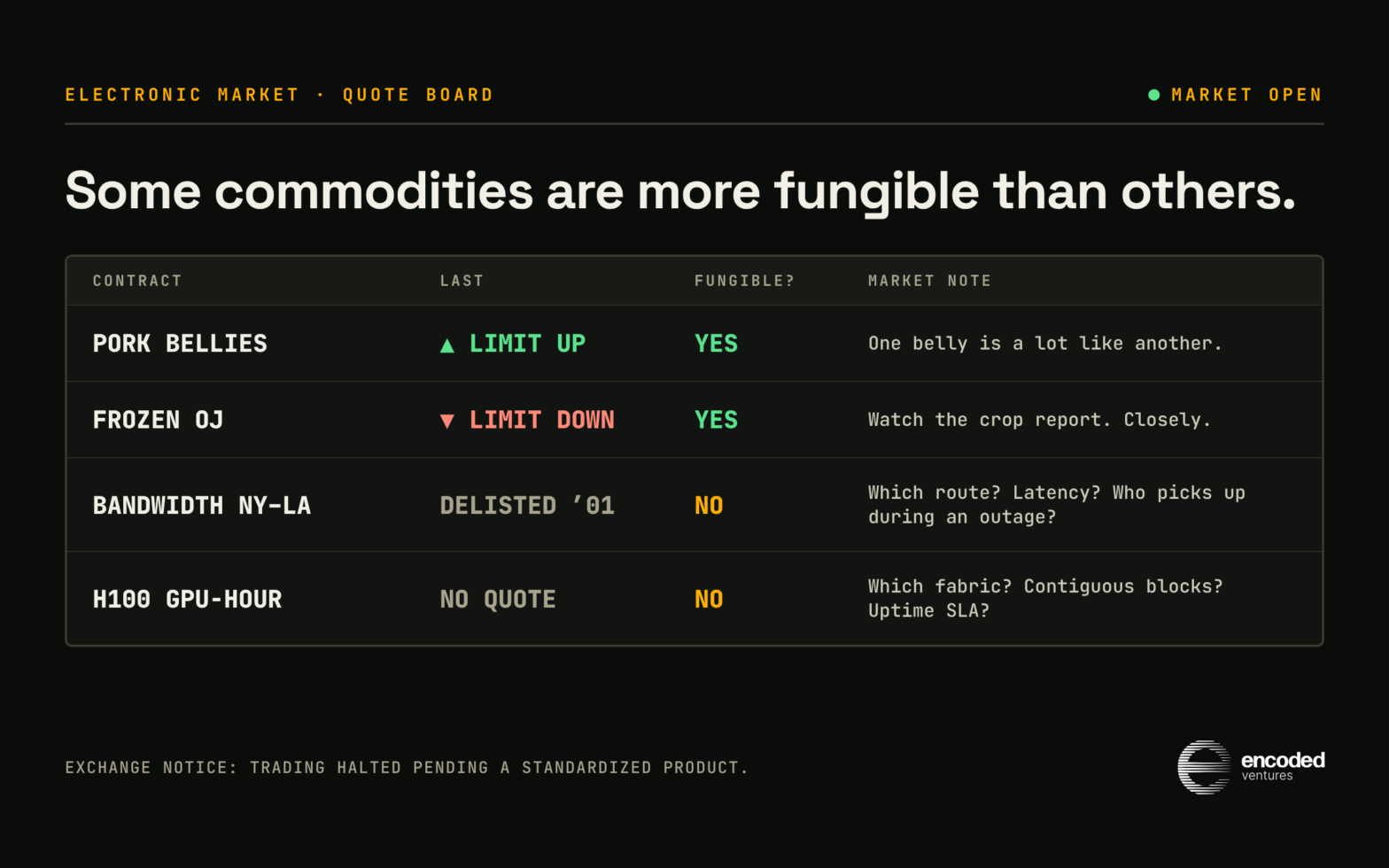
Enron promised bandwidth would trade “like pork bellies,” and for most of my generation, everything we know about pork bellies came from the Duke brothers explaining them to Billy Ray Valentine in the movie Trading Places. But pork bellies and orange juice (the trade that sinks the Duke brothers in the film’s climax) are fungible in a way bandwidth never was.
The lesson I took away from the bandwidth era is that infrastructure capacity is never as fungible as the people building exchanges want it to be. A wavelength between New York and Los Angeles looks like a commodity on a term sheet, but in practice it comes with:
- a specific route, specific latency, specific diversity from your other circuits
- specific carrier hotels at each end, and a specific counterparty you either trust or don’t.
It also ended up mattering who operated those waves, if they met certain SLAs, and if they could send an accurate bill or pick up the phone during an outage.
Buyers cared about all of these things, which is why most capacity kept moving through bilateral contracts negotiated by people who knew each other.
In every cycle, the traders, quants, and other financial market participants get googly-eyed over the latest tech wave and set out to turn its scarcest input into something they can trade. We’ve tried this three times in the modern era: bandwidth in the late 1990s, compute exchanges in the cloud era (Jake mentions Deutsche Börse’s attempt in 2015, and CME Group tried it in 2014 with 6Fusion and its workload allocation cube, the “WAC”), and now GPUs.
An H100 hour sounds standardized until you ask which interconnect it sits on, how many of them are in the same NVLink and InfiniBand domain, what the storage and networking look like, where the data lives, what the uptime history of the provider is, and whether the cluster is still available in contiguous blocks when you need to scale a training run.
A frontier lab training across 20,000 GPUs and a startup running inference on eight are not buying the same product.
When I ask people building in this space why it’s different this time, the best answer I’ve gotten is that more money is at stake. I don’t find that satisfying. More money at stake is a reason people want a market to exist, not evidence that the product underneath it has become standardized enough to support one.
The fiber overbuild was rational. GPUs are different.
Jake groups the railroads and fiber together as overbuilds, and in terms of outcome he’s right, but the economics behind the fiber overbuild were different in a way that is relevant for the GPU comparison.
In long-haul fiber, most of the cost of a route is the right-of-way, the permits, and the trench. Once you dig a trench, the incremental cost of pulling 64 or 128 fibers instead of one is rather small. As such, every builder put in far more glass than they could light. Then DWDM kept multiplying the capacity of each strand, so the same physical plant could carry many times more traffic just by upgrading the electronics on each end.
That’s why supply got so far ahead of demand, and it’s also why the overbuild eventually paid off for whoever ended up owning it. The dark fiber sat in the ground for a decade with almost no carrying cost beyond the debt, and demand did eventually catch up: video, cloud, mobile backhaul and data center interconnect lit up glass that had been written down to near zero.
GPUs simply don’t work that way. There’s no trench to amortize. Every unit of capacity carries real incremental cost: the chip, the server, the networking, and the power and the cooling, all of which scale roughly linearly with the capacity you add. A GPU that sits idle isn’t a cheap option on future demand the way dark fiber was. It’s a depreciating asset with a useful economic life measured in a chip generation or two, sitting in a data center with a lease that may run 10+ years. And unlike fiber in 2001, we’re still in a supply-constrained market, which makes understanding true demand extremely complicated: when everyone is short capacity, it’s hard to tell real end-customer demand from labs and hyperscalers hoarding against the next shortage.
Debt decides who keeps the asset
My broader view is that any time technology (which has traditionally been financed with equity) meets an asset-heavy business that has to be financed with debt, the road is going to be rocky. This is especially true in a bull market when exuberance makes both kinds of capital cheap.
Equity investors are underwriting a technology bet and can tolerate a wide range of outcomes; lenders are underwriting predictable cash flows from a durable asset and can’t. When a fast-moving technology gets financed like a toll road, the debt assumes a stability profile that the technology can rarely deliver on. It’s usually the lenders and the late equity who find that out first.
The thing that separates winners from losers in an infrastructure cycle isn’t the quality of the asset. It’s the capital structure sitting on top of it. In any boom, some companies get their cap structure upside down, borrowing against peak pricing and assuming the scarcity lasts as long as the loan, while others stay more measured, matching the duration of their debt to the duration of their contracts and keeping enough equity in the business to survive a bad couple of years. When the cycle turns, the asset almost always survives. The question is whose balance sheet it ends up on.
Telecom is the clearest example I know. The fiber that Global Crossing and others put in the ground in the late 1990s still carries traffic today, but the equity holders and many of the bondholders who paid for it were wiped out long ago. Jake notes that Global Crossing sold for a penny on the dollar. The network was fine; the debt was the problem. Prices for capacity fell much faster than the interest payments did, and once lenders started making collateral calls there was nobody left to refinance into.
The numbers in Jake’s post suggest some of today’s neoclouds are heading into that same position. He cites CoreWeave at roughly 16 cents of cash per dollar of debt and Cipher at about 12, CoreWeave’s 2031 bonds moving from under 10% to over 16% since April, and its five-year credit default swaps hitting a record 1,268 basis points on November 5 (against roughly 60 for Microsoft and 90 for Alphabet a week earlier). That spread is the market telling you who it thinks owns the asset in the downside case.
The mismatch I’d watch most closely is duration. A GPU’s premium pricing may survive throughout a chip generation, call it two to three years, while the debt used to buy it and the data center lease that houses it can run far longer. If the loan is underwritten against today’s rental rates and those rates fall when the next generation ships, the borrower is servicing a fixed obligation with a shrinking revenue line. The companies that come through this well will be the ones that financed GPUs against contracted revenue of matching length, with creditworthy counterparties, and didn’t stack more leverage on top.
Of course, this cuts both ways. Leverage is also why some of these companies were able to bring capacity online fast enough to win customers in the first place, and not every neocloud is levered the same way. But in my experience the measured operators rarely get the headlines on the way up, and they’re usually the ones still standing when the consolidation starts.
Why older GPUs are getting more expensive
The rental market is sending a signal right now: older GPUs are getting more expensive, not cheaper. Silicon Data’s index had H100s near $2.00 an hour in late 2024 and $2.41 by February 2026, with A100s at $1.38, and neocloud H100s were running around $2.75 by July. My view is that this is mostly a facility story. Nvidia’s newest systems (such as the GB200 NVL72) draw roughly 120 kW per rack and need liquid cooling, so they can’t go into most existing data center space. Hopper is air-cooled and fits into powered capacity that already exists, so it’s absorbing demand that would otherwise go to the next generation.
If that’s right, the timing of the price decline depends less on when Nvidia ships and more on when liquid-cooled, powered capacity comes online, which takes longer than a chip ramp. Once it does, the cost per token on Blackwell and Rubin makes it hard to rent Hopper at today’s rates. Growing inference demand may keep older GPUs busy and soften the fall, but I’d be cautious about any loan underwritten against 2026 H100 rental rates. Those rates include a scarcity premium tied to cooling and power, and that premium goes away when the data center industry brings more of the right supply online.
What consolidation looks like from the inside
Jake’s point that strong balance sheets buy the wreckage cheap is exactly right. Two companies from the telecom bust show how it works.
The first is a nice irony: Enron’s bankruptcy gave us Switch. Enron Broadband Services had built a facility on East Sahara Avenue in Las Vegas to be the operational center of its bandwidth trading business, and had paid millions of dollars to get more than 20 carriers to run fiber into it. It went bankrupt about a week before the building was ready to open. Rob Roy, whose small colocation business was across the street, spent about nine months pulling it out of bankruptcy, and in December 2002 court records show the 12,000 square foot facility selling for $930,000. That carrier density became the foundation of Switch and the SuperNAP campus that followed. Enron’s bet on bandwidth as a tradeable commodity failed, but the physical interconnection it paid for turned out to be enormously valuable to someone who bought it at the right price.
The second is one I was part of. In 2007, Battery invested in the formation and first round of the company that became Zayo. Dan Caruso and John Scarano, both former Level 3 and ICG executives, started the company with Matt Erickson under a holding company called Communications Infrastructure Investments, and in August 2007 announced $225 million in equity commitments led by Oak Investment Partners, Columbia Capital and M/C Venture Partners, with Battery and Centennial Ventures participating. Rick Frisbie led the investment for Battery, and I was the associate working with him. The premise was simple: there was a lot of fiber in the ground, much of it regional, underused and owned by people who either didn’t want it or couldn’t afford to keep it, and it could be bought for well under what it cost to build.
The early deals show what that looked like. Zayo’s FY2011 10-K lists Memphis Networx for about $9.8 million in July 2007, PPL Telcom for about $56.7 million a month later and Onvoy for about $77.2 million that November, followed in 2008 by assets bought out of the Adesta Secured Creditors Trust for about $6.4 million. The same filing records a gain on bargain purchase in fiscal 2010, an accounting acknowledgment that the fair value of assets acquired exceeded what Zayo paid. Over the next seven years Zayo made more than 30 acquisitions, including 360networks (itself a casualty of the original bust) and AboveNet for $2.2 billion in 2012. It went public in 2014 and was taken private in 2020 by EQT and Digital Colony in a deal valued at $14.3 billion.
The lesson from Zayo isn’t that fiber was a great business in 2001. It wasn’t, at least for the people who built it with borrowed money. The lesson is that the asset was durable, demand eventually showed up, and the returns went to the patient capital that bought it after the overlevered owners were gone. If the GPU cycle ends the way Jake predicts, I’d expect a similar pattern, with one big caveat: GPUs depreciate much faster than glass (and are arguably much more complex systems to operate and consume), so the window to buy distressed capacity and grow into it is measured in a couple of years, not a decade. The more durable assets this time may be the powered land, the interconnection and the data center shells, not the chips and servers inside of them.
What I’d take from this
The question I come back to is whether anything about GPU compute in 2026 is structurally different from bandwidth in 1999.
- The product is more complex, not less.
- The supply side has real marginal cost, so there’s no cheap overbuild waiting to be grown into.
- And the buyer base, at least today, is concentrated in a handful of labs and hyperscalers who prefer to negotiate directly.
None of these factors point toward a liquid, standardized market.
I’m not suggesting that the AI buildout is a mistake. The railroads were real, the internet was real and AI is real, as Jake puts it. It means the returns will be decided less by who builds the most capacity and more by who builds it with a capital structure that survives a down cycle, and by who is positioned to buy capacity cheaply when others can’t hold on.
For founders, I suggest being measured about leverage even when the market is throwing debt at you. For investors, I suggest keeping some dry powder and some patience, because the best entry point in infrastructure has historically been before the frenzy or after it, not during it.
-ab